Above: Fliteshop (Andy Malchiodi and Jason Peters with camera flyer Taylor Buffington) perform block six, Gears, over Skydive Arizona in Eloy. Photo by Seth Robison.
Mixed formation skydiving is the fastest-growing discipline you’ve maybe never heard of. Those who have drunk the MFS Kool-Aid will tell you that it stands for “Most Fun Skydiving.” And why is that? MFS borrows from several other competitive disciplines, giving it a unique feel while offering something for every kind of skydiver. It also has a low barrier to entry: All you need is a friend and appropriate gear.
What is MFS?
In 2013, world-champion skydiver Andy Malchiodi collaborated with other leaders in the sport to create something new. They crafted a preliminary dive pool fashioned from existing ideas such as the old artistic compulsories, Jason Peters’ “Gauntlet” tunnel competition series and other original concepts. Malchiodi packaged up a proposal for a brand-new discipline and sent it to USPA—and mixed formation skydiving was born.
2013 was a wildly successful test year at the USPA National Championships, cementing USPA’s decision to officially add MFS to Nationals the following year. Today, Malchiodi and Peters sit atop the MFS world as members of reigning national champion team Fliteshop.
But how is it done? Mixed formation skydiving teams consist of three people: two flyers who perform a sequence of formations and a camera flyer who captures the action. The MFS dive pool allows participants to fly in all four basic body orientations: belly, back, head-up and head-down. It deliberately mirrors that of the other formation skydiving disciplines, containing 22 block sequences and 16 random formations. Just like in formation skydiving, a random is a single, static formation that is worth one point. A block is a two-point formation that includes a starting formation, a prescribed maneuver called an “inter” and a final formation.
Of the 16 MFS random formations, six are in a horizontal orientation (belly and back) and 10 are in a vertical orientation (head-up and head-down). Of the 22 MFS block sequences, six are horizontal, 14 are vertical and two are a hybrid of horizontal and vertical flying. MFS does include a variety of three-dimensional maneuvers, such as eagles and layouts, that no other formation skydiving discipline uses.
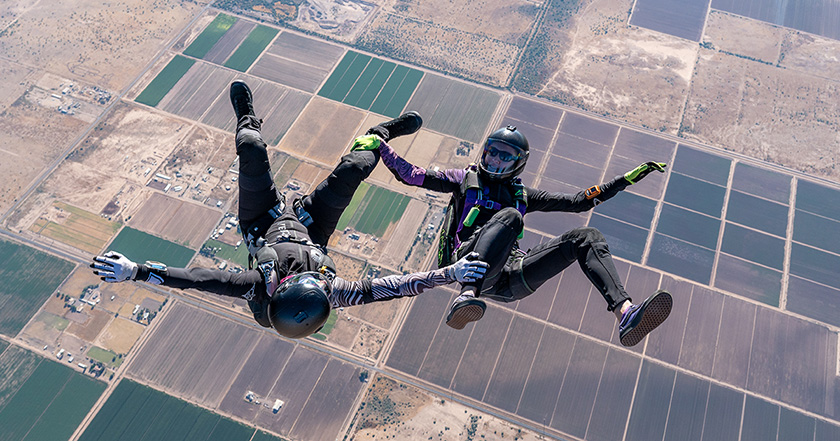
Seeing Double (Michelle Hart and Irina Meshcheryakova) take grips on a vertical-compressed formation. Photo by Matthew Fry.
Getting Started
MFS is accessible, practical and beneficial at every stage of your skydiving progression, with a flexible dive pool that supports a variety of skill sets. It works at any drop zone, even those with smaller aircraft. All it takes is one other person to start practicing.
At the foundational level, MFS offers 12 fun and challenging formations that are exclusively belly and back-flying, with no vertical flying required. These flat formations are a great starting point for people who haven’t yet progressed into vertical flying.
For those wishing to incorporate head-up with horizontal flying—this is what intermediate MFS is all about. This class is the starting point for MFS competition. The intermediate dive pool contains eight random formations and eight blocks that are entirely belly, back and head-up flying. This gives newer freeflyers a unique opportunity to be a part of structured skydives and get involved in competitive skydiving.
Once you are flying head-down in the sky, you can begin dabbling with the advanced dive pool. There are 13 randoms and 18 blocks to choose from in the advanced dive pool. Of these 31 formations, there are eight formations that require only one flyer to ever be head down, offering a logical starting point and excellent way to progress from the intermediate to advanced class in a safe manner.
So, starting with MFS is simple: grab a partner, review the dive pool and make some jumps.
If you want to grow within the discipline, choose a partner with similar resources and aligned goals. That matters more than matching skill levels. Have an early conversation about how much time and money each person can commit to training—clear expectations prevent frustration later. Agreeing on both short- and long-term goals also helps ensure a good fit for the season and beyond.
For competition information, the best source is uspa.org and the official Skydiver’s Competition Manual. The complete MFS dive pool is in Chapter 9, pages 28-32.
Other resources include:
Fliteshop Cloud League: A community of MFS flyers sharing tips, move explanations, and direct access to nine-time national champion team Fliteshop. This initiative is a valuable entry point for both new and experienced flyers.
SDCMatriX.com: Run by fifth-year MFS team SDC MatriX, the site hosts the dive pool, rules, competition archive, instructional videos and (soon) an MFS draw generator.
Safety Considerations
The extreme fall-rate changes unique to mixed formation skydives create the need for additional safety considerations. Equipment should be freefly friendly. Ensure your container securely protects the main and reserve flaps and riser covers, which should remain closed in the wind. Use a low-profile main deployment handle with a secured tuck tab to prevent premature deployment and opt for a reserve pillow instead of a metal D-ring. It is highly recommended to have an automatic activation device, and at least one, preferably two, audible altimeters.
Because the MFS dive pool includes technical dynamic maneuvers, start with linear blocks and randoms to build control and confidence before attempting more complex moves.
Mixed formation jumps deserve extra attention when it comes to deciding exit order. A mixed group will likely get more freefall drift than a vertical group but not as much as a belly group. If the skydive will include both flat and vertical flying, the logical place to exit is after the belly-flyers but before the freeflyers.
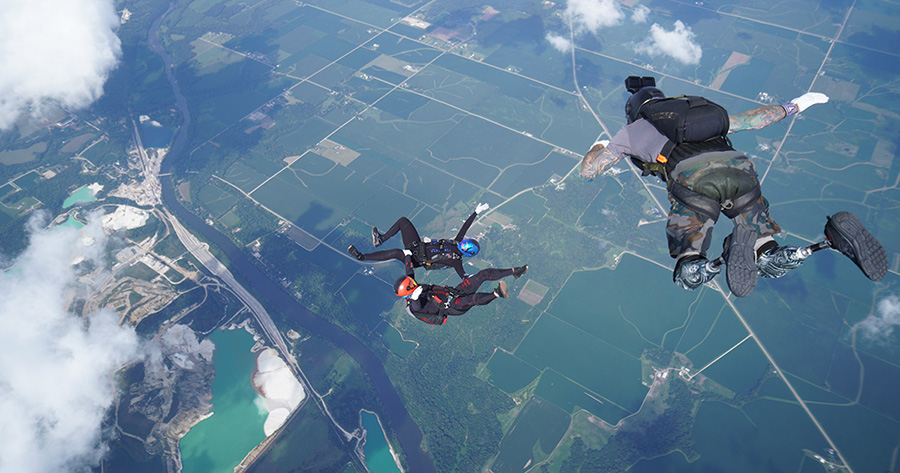
SDC MatriX (Joey Baker and Lindsay Fener with camera flyer Nick Fener) complete random formation F, Belgian Waffle, at Skydive Chicago in Ottawa, Illinois. Photo by Kacey Crippin.
 Events Around the Country
Every winter at Skydive Arizona in Eloy, Fliteshop hosts two separate MFS scrambles competitions. There is no registration fee to attend these fun and informative events, and they are an invaluable opportunity to learn from the founders of MFS.
SDC MatriX hosts events in the summer at Skydive Chicago in Ottawa, Illinois, and in the winter at Skydive Sebastian in Florida. They run scrambles similar to Fliteshop’s format and also offer workshops, including detailed seminars and the ability for participants to jump with the same partner all day, practicing design and execution from the MFS dive pool. Attendees leave with new tools to create successful mixed formation jumps with friends.
Advanced MFS team New Shoe Crew has also begun hosting events for its community at Skydive Orange in Virginia. Recently, pop-up MFS events have also appeared at Start Skydiving in Middleton, Ohio, Skydive Perris in California, and Skydive Paraclete XP in Raeford, North Carolina. Check USPA’s events listings in Parachutist or at uspa.org/events to find an MFS event near you.
The World Stage
MFS is the only official USPA formation skydiving event that is not recognized or included in the Fédération Aéronautique Internationale Formation Skydiving World Championships or World Cup competitions overseen by the International Skydiving Commission.
The hosts of the 2024 FAI World Skydiving Championships in Beaufort, North Carolina, created an unofficial MFS world meet exhibition event to run alongside the official FAI competition. Nine open-level teams attended this world meet. One team represented Australia, while the rest came from all over the U.S. Fliteshop surprised nobody by earning the gold medal.
Give MFS a Try!
No matter your level in the sport, mixed formation skydiving can be incorporated into your skydiving life right away—with a little bit of forethought. Utilize the resources in this article and check out the MFS dive pool. Then grab a friend and go jump! If you do, your next trip to the drop zone could be the Most Fun Skydiving you’ve ever had.
 About The Author
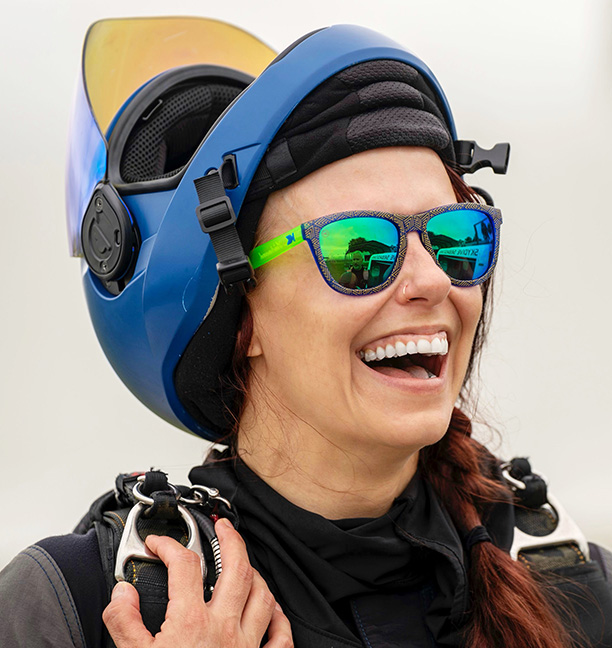
Lindsay Fener, D-29657, started skydiving in 2004 and never looked back—5,500 jumps later, she is still a dedicated student of the sport. A safety-focused skydiver and former AFF instructor, she has brought that same passionate energy to the MFS competition scene since 2021, earning three national podium finishes along the way.