Photo by Joe Jennings.
Directed by first-time filmmaker Bryce Leavitt and co-directed by award-winning documentarian Marah Strauch, “Space Cowboy” is a feature documentary about freefall cinematographer and stunt coordinator Joe Jennings. The film explores the human story behind the iconic images, tracing Jennings’ creative evolution, personal struggles and continued influence on aerial cinematography.
Parachutist sat down with the directors to learn more about the film.
What inspired you to tell Joe’s story?
Leavitt: I was working on a commercial in Los Angeles and needed someone to shoot a skydiving scene. I remember thinking, who actually does that? Is that even a thing, or do I just need someone with a GoPro? I googled “Los Angeles aerial videographer” and landed on Joe Jennings’ website. I thought, “Holy ****!” I reached out to Joe, we hit it off right away and I was absolutely blown away by his craft. I didn’t even know this world existed.
Long story short, I set out to make a movie, something I had never done before. I started thinking about filmmakers whose work inspired me, and the film that felt most aligned was “Sunshine Superman,” about the father of BASE jumping, Carl Boenish. I cold emailed the director, Marah Strauch, who I didn’t know at the time. We got on a call, she gave me some first-time filmmaker advice, and I found myself gravitating toward her. I kept calling, and somewhere along the way she said, “Let’s make the damn thing.”
Strauch: I already knew about Joe Jennings because, strangely enough, he ended up buying Carl Boenish’s cameras. Some of the footage in “Space Cowboy” was actually shot on the same cameras Carl flew with, which felt kind of magical. It immediately made sense to me.
I also wanted to help Bryce because I understood the abyss you face when making your first film, especially when working with very large archives. I’d been through that myself on “Sunshine Superman,” so I knew how challenging that process could be and how overwhelming it feels early on. This film felt like a natural next step for me, working with Bryce and applying what I’d learned. It all came together in a very organic way.
Leavitt: One other thing I want to mention is that while our initial call may have been random, the partnership was not. What struck me early on, and really guided the entire process, was that despite coming from very different backgrounds and worlds, Marah and I saw the film the same way from our first creative conversation. We were very aligned on what we loved about the story and how we wanted to shape it for an audience. That was a big reason I gravitated toward her and why she may have taken a chance on partnering with a first-time filmmaker, something not a lot of filmmakers would do. I feel very lucky, but looking back, it all came down to how similarly we viewed the story from the start.
Strauch: Yeah, for me it was about approaching skydiving from a human perspective rather than just the spectacle. That was really important in “Sunshine Superman,” What Bryce brought to the table was a genuine desire to tell Joe’s story as a full person, someone who struggles with grief, with ADHD, with real human challenges, not just the thing he does in the air. That felt like a smart and honest way to tell the story and it aligns with how I approach films about extreme sports athletes. It made a lot of sense for both of us.
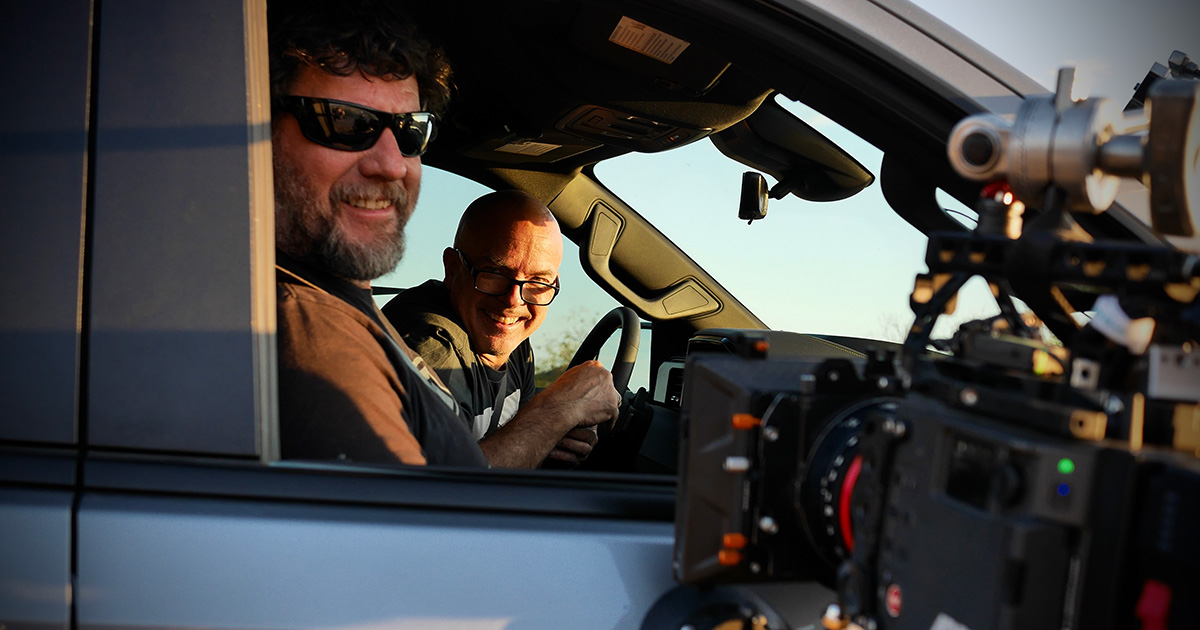
Joe Jennings (driver seat) and Steve Curtis on the set of “Space Cowboy.” Photo courtesy of the filmmakers.
Carl Boenish and Joe Jennings are both aerial cinematographers; do they share any similarities?
Strauch: I think Carl and Joe share a constant drive to innovate and find new angles, not just skydiving for its own sake, but using it to capture a truly unique perspective. It wasn’t about showing the drop zone to the people already there, it was about showing the world what was possible. Carl wanted to reveal what BASE jumping and skydiving could be in order to inspire others, and I think Joe has a very similar impulse. Whether it’s making people laugh or helping them get out of their own way, both of them ultimately wanted to inspire others through skydiving.
Leavitt: Beyond the creative side, there’s also the infrastructure and evolution of the craft, and Joe is very gracious about acknowledging the people who laid the foundation for his career. Whether it’s Carl Boenish, Ray Cottingham, Norman Kent or Tom Sanders, there were a lot of people operating at a high level before, and as, Joe came into the sport. Joe is very self-aware and genuinely grateful to that group. He understands that the way he revolutionized his corner of the sandbox was built on the shoulders of what those great skydivers and camera flyers had already done.
What was your favorite part of making this documentary?
Leavitt: That’s a tough one. There’s the sentimental side of looking back on a five-year process that became such a huge part of my life. But if I had to give a quick answer, it would be the day of the big car drop at Skydive Arizona in Eloy.
We were out in the desert, Joe was up in the plane with the car and our crew was on the ground with about 20 cameras, all of us looking up at a plane that was about to drop a car. The Skydive Arizona team was running around on radios calling out the timing, and Marah and I were just standing there. I remember looking at her and saying, “Oh my God, what have we done?”
Then the car dropped and everything went exactly the way it was supposed to. It was one of the coolest experiences of my entire life, and the fact that it was so successful made it even better.
Strauch: I agree. That was definitely a high point for us. It was about taking an idea that existed in Joe’s head and turning it into reality, which is always what you want as a filmmaker. In documentaries, it’s rare to work with a crew that large or to be in a situation where you’re really directing something on that scale.
Bryce and I were able to use more cameras than most documentaries ever have, and it was incredible to see all the footage come back. Even more exciting was realizing that people actually got the shots we were hoping for. It felt like opening a gift, seeing the drone shot of the car hitting the ground and knowing it worked. It was like Christmas morning, realizing the footage was there and that the film was going to have something truly special in it.
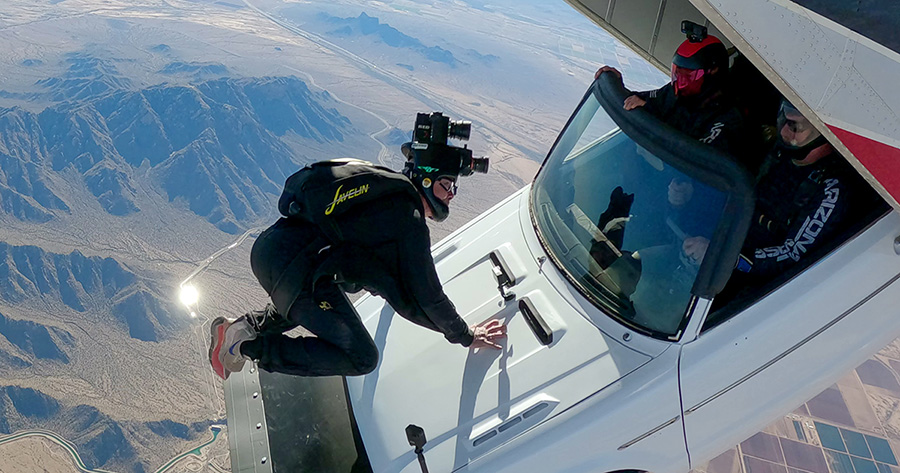
Joe Jennings captures the car exiting the Skyvan over the desert during the documentary’s filming. Photo courtesy of Mark Kirschenbaum/Hypoxic.
What message do you hope people take away from this film?
Leavitt: We were really excited because it felt like a gift to have a subject whose story is so raw and deep, but ultimately arcs in an uplifting way. The message, for me, is about finding art in anything, expressing yourself in whatever strange or personal way works for you and taking a marathon stance that things are going to be okay. Things do get better.
What’s been most rewarding is when people come up to us after screenings and talk about how much the film resonated with them, or when they go straight to Joe and say they’ve had similar experiences with anxiety or depression. That’s the power of the film for me. It’s about owning your demons, owning your downfalls, and finding ways to move through them with love and self-expression.
Strauch: What’s great about this film is that it’s genuinely fun. You go on a ride that’s entertaining, but there’s also a deeper message that Joe opens up about in a very honest way. It’s about not stigmatizing mental health struggles, being open about your own experience and even using something like skydiving in a therapeutic way.
For me as a director, that’s important because the film isn’t really about skydiving. It’s about something much bigger. We think it will resonate with skydivers, but also with people who have nothing to do with skydiving at all. The hope is that it inspires people to do whatever makes them feel alive and expressive in their own lives.
Who should see this film?
Strauch: Well, everybody, of course! It’s a fun film, and I think people sometimes hear “documentary” and expect something pretentious, but this isn’t that. It can play on a high-art film festival stage, but it also works for people who just want to enjoy a great experience on a big screen. I really encourage people to see it in theaters because it’s immersive in a way that’s unusual.
When “Sunshine Superman” came out, one of my favorite things was seeing people drag their families along so they could understand why they wanted to BASE jump. This film does something similar. You can bring friends who don’t understand skydiving and let the film show them what makes it exciting. I think it can be a great tool for that.
Leavitt: Marah nailed it. We saw on the film festival circuit that it truly connects with all kinds of audiences. We premiered in Toronto, which is a very prestigious festival, and had critics, moviegoers and skydivers from local drop zones all loving it. Then we played in Hot Springs, Arkansas, to an audience largely made up of couples in their 60s and 70s, and it sold out. The next weekend, we played Newport Beach with a completely different demographic, and it resonated there too.
Joe’s story and Joe’s art, combined with our commitment to staying true to that, created something that can resonate with just about anyone. We’re proud of that.
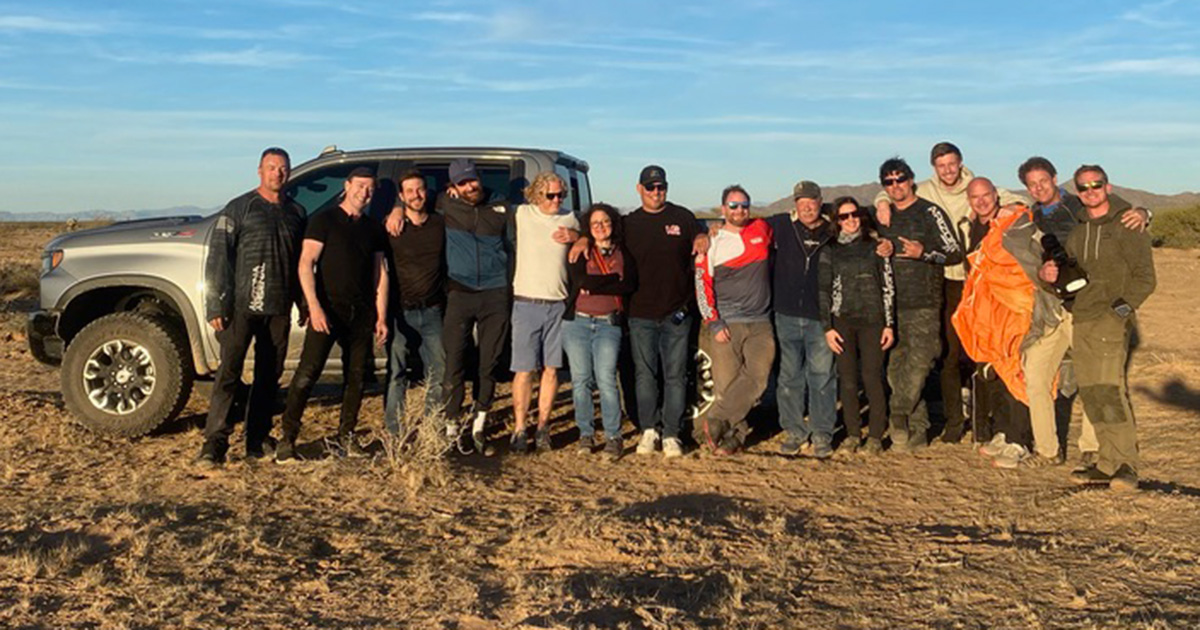
The documentary crew gather for a photo after filming. Photo courtesy of the filmmakers.
The film premiered at the 2024 Toronto International Film Festival. Abramorama acquired the theatrical rights is bringing the documentary to North American audiences. The trailer and more information about the film is available at spacecowboymovie.com.