Above: Photo by Craig O'Brien.
At 13,000 feet above the earth, suspended in the doorway of an aircraft traveling at 120 miles per hour, the human mind faces a test that evolution never prepared it for. The decision to step into empty space, with nothing but trust in fabric and string to prevent death, represents one of the most profound challenges to human psychology ever devised. Yet, thousands of people make this choice every day, and their survival depends largely on psychological characteristics that most people never develop—and many never understand.
The margin for error is measured in seconds, the consequences of failure are absolute and the environment provides no forgiveness for weakness, hesitation or poor judgment. The sky is the ultimate selector, and its selection process is neither random nor mysterious. Through careful analysis of accident reports, psychological studies and extensive interviews with long-term survivors, clear patterns emerge that distinguish those who thrive in the sport. Here, we term these characteristics the “Four Pillars of Survival Psychology.”
Pillar One: Mental Discipline
Mental discipline represents the cornerstone of survival psychology in skydiving, encompassing cognitive capabilities that exceed those found in virtually any other human activity. This pillar involves the ability to maintain clear, logical thinking while facing immediate mortal danger, processing multiple life-critical variables simultaneously and making complex decisions under extreme time pressure.
The cognitive demands of skydiving are staggering in their complexity and intensity. During a typical freefall, skydivers must continuously monitor altitude while assessing body position and stability, track other skydivers in formation while evaluating weather conditions, and prepare for parachute deployment while maintaining spatial awareness in three dimensions without normal visual references. This cognitive load would overwhelm most people under normal circumstances, but skydivers must manage it while falling at terminal velocity with their lives depending on every decision.
Mental discipline in skydiving manifests in several specific ways. First is the ability to compartmentalize fear and anxiety, acknowledging these natural responses without allowing them to interfere with cognitive processing. Successful skydivers develop what psychologists term “functional fear,” or the ability to use fear as information while preventing it from degrading performance.
Second is the capacity for rapid situational assessment and decision making. In skydiving, situations can change from routine to life threatening in seconds, requiring immediate recognition of problems and implementation of appropriate responses. This capability goes beyond simple pattern recognition to include the ability to synthesize multiple sources of information, evaluate options under time pressure and commit to action despite uncertainty about outcomes.
Third is the maintenance of what military psychologists call “cognitive reserve,” or the ability to continue thinking clearly even when primary cognitive resources are overwhelmed by stress. This involves developing backup mental processes that can function when normal thinking is compromised by fear, adrenaline or sensory overload. Skydivers who survive serious emergencies consistently demonstrate this ability to access alternative cognitive pathways when their primary mental processes are disrupted.
Pillar Two: Physical Control
Physical control in skydiving extends far beyond normal athletic capabilities, requiring the human body to function as a precise control surface in an environment where aerodynamic forces replace normal physical references. At terminal velocity, the body becomes the primary means of navigation and control, demanding exceptional proprioceptive awareness, muscular coordination and biomechanical efficiency that challenge every aspect of human physical performance.
The biomechanical requirements of skydiving are unique in human experience. Unlike ground-based activities where gravity provides a constant reference point, skydivers must maintain control in three-dimensional space where small changes in body position create large changes in trajectory and stability. The forces involved are substantial—a skydiver in freefall experiences wind resistance equivalent to standing in a hurricane yet must maintain precise control over body position and movement within this environment.
Successful physical control requires the development of what aerospace physiologists term “spatial proprioception,” or the ability to sense body position and movement in three-dimensional space without visual or gravitational references. This capability must be developed through extensive training because the human vestibular system, evolved for ground-based movement, provides unreliable information during freefall. Skydivers must learn to rely on alternative sensory inputs and develop new neural pathways for spatial awareness.
The muscular demands of skydiving are equally challenging. Maintaining stable body position during freefall requires sustained isometric contractions of core muscles while simultaneously making fine adjustments with extremities. This combination of stability and mobility demands exceptional muscular coordination and endurance. Additionally, skydivers must be able to make rapid, powerful movements when necessary while maintaining overall body control—a combination that requires both strength and precision.
Pillar Three: Emotional Stability
Emotional stability in skydiving encompasses the ability to function effectively while experiencing fear, anxiety and other intense emotions that would normally overwhelm cognitive and physical performance. This pillar involves not the absence of emotion, but rather the ability to experience intense emotions without allowing them to degrade performance or decision-making capabilities.
The emotional challenges of skydiving begin long before the aircraft reaches altitude. The anticipation of jumping can trigger anxiety responses that interfere with preparation, equipment checks and pre-jump procedures. During the climb to altitude, skydivers must manage increasing anxiety while maintaining focus on safety procedures and jump planning. The moment of exit from the aircraft represents perhaps the most intense emotional challenge in human experience—the conscious decision to step out of that door despite every survival instinct screaming against it.
During freefall, emotional management becomes even more critical. The sensory experience of falling at terminal velocity can trigger panic responses that override rational thinking and motor control. Skydivers must maintain emotional equilibrium while experiencing sensations that the human nervous system interprets as immediate mortal danger. This requires a level of emotional regulation that most people never develop, and many cannot achieve even with extensive training.
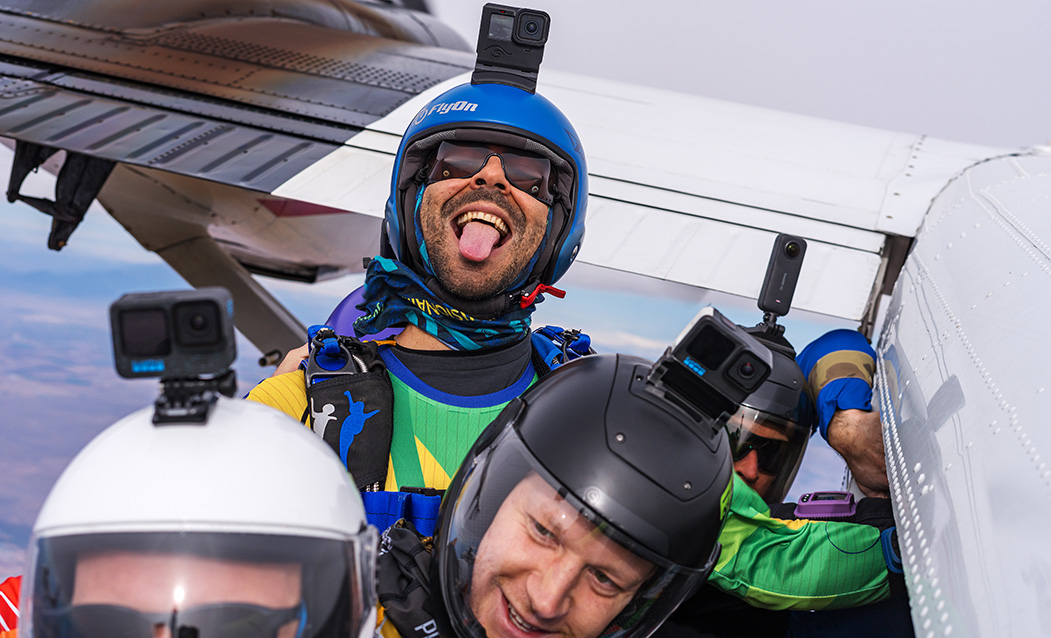
Photo by Ewan Cowie.
Pillar Four: Respect for Risk
Respect for risk represents perhaps the most paradoxical aspect of survival psychology in skydiving. It involves the ability to acknowledge and accept the inherent dangers of the activity while maintaining the confidence necessary to participate effectively. This pillar requires a sophisticated understanding of risk that goes beyond simple fear or reckless courage—a mature appreciation for the forces involved and the limitations of human control.
The development of appropriate risk respect begins with understanding the fundamental nature of skydiving as an activity where death is always possible regardless of skill level, equipment quality or safety procedures. This understanding must be complete and visceral, not merely intellectual. Skydivers who thrive consistently in the long term demonstrate a deep appreciation for the fact that they are engaging in an activity where small errors can have fatal consequences and where some factors remain beyond human control.
Respect for risk manifests in several specific ways. First is the development of what safety professionals term “chronic unease,” a constant awareness that things can go wrong despite apparent safety. This involves maintaining vigilance and attention to detail even during routine operations, recognizing that complacency is often the precursor to accidents. Second is the ability to make conservative decisions when conditions are marginal, even when this means missing opportunities or appearing overly cautious to others.
The balance between respect for risk and operational effectiveness is delicate and requires constant adjustment. Too little respect for risk leads to reckless behavior and eventual accidents. Too much respect for risk can lead to paralysis and inability to function effectively in the skydiving environment. The optimal balance involves what psychologists term “calibrated confidence,” or confidence that is proportional to actual capability and appropriate to the specific situation.
Training the Mind for Survival
The foundation of effective psychological training lies in the concept of stress inoculation—systematic exposure to progressively challenging stress levels under controlled conditions. This approach allows individuals to develop confidence and coping strategies while building tolerance for the physiological and psychological effects of extreme stress.
Stress inoculation training begins with exposure to mild stressors that challenge individuals without overwhelming their coping capabilities. In skydiving training, this might involve practicing procedures while experiencing moderate time pressure or physical discomfort. As individuals demonstrate mastery at each level, stress levels are gradually increased until they approach those encountered in real emergency situations.
The progression of stress exposure must be carefully managed to avoid overwhelming individuals while ensuring that training stress levels are sufficient to develop real capabilities. Too little stress fails to develop the psychological resilience necessary for emergency situations. Too much stress can be counterproductive, leading to learned helplessness or avoidance behaviors that interfere with effective performance.
Cognitive training for skydiving must address the specific mental challenges of operating in extreme environments where normal cognitive processes may be disrupted by stress, time-pressure and sensory overload. This training must go beyond simple knowledge acquisition to include development of cognitive skills that can function under adverse conditions.
Working-memory training is particularly important because emergency situations often require holding and manipulating multiple pieces of information simultaneously while executing complex procedures. Traditional training that focuses on individual procedures may not develop the cognitive capacity necessary for managing multiple concurrent tasks under stress.
Emotional regulation training is essential for developing the psychological capabilities necessary for effective performance under extreme stress. This training must address both the cognitive and physiological aspects of emotional response while providing practical techniques that can be implemented under real emergency conditions.
Learning the Right Way
The Four Pillars of Survival Psychology (mental discipline, physical control, emotional stability and respect for risk) are not specific to skydiving, but represent fundamental psychological capabilities required for effective performance under extreme stress. These capabilities are relevant to any situation where split-second decisions, precise motor control, emotional regulation and accurate risk assessment determine outcomes.
The findings of this analysis suggest that traditional approaches to training for extreme environments can be inadequate when they focus primarily on technical skills while neglecting psychological development. Effective training for extreme environments must address psychological capabilities with the same rigor and attention to detail that is applied to technical training.
Ultimately, the decision to participate in extreme environments like skydiving is a personal choice that each individual must make based on their own values, capabilities and risk tolerance. The research presented in this analysis provides information that can inform this choice, but it cannot make the choice for anyone.
What this research does suggest is that the choice to participate in extreme environments should be made with full understanding of the psychological demands involved. Individuals who choose to participate should be prepared to invest the time and effort necessary to develop the psychological capabilities required for safe participation. They should also be prepared to honestly assess their own psychological characteristics and to make difficult decisions about their continued participation if they discover that they lack necessary capabilities.
The sky does not care about our confidence, our experience or our personal beliefs about risk. It responds only to our psychological fitness—our ability to think clearly under extreme stress, to control our bodies and emotions in life-threatening situations and to make decisions that acknowledge both our capabilities and our limitations.
For those who possess or can develop these psychological capabilities, skydiving offers an unparalleled opportunity to test themselves against the ultimate challenge and to experience the profound satisfaction that comes from mastering one of humanity’s most extreme pursuits. For those who lack these capabilities, the honest recognition of this fact may be the most important survival skill of all.
 About the Author
Karim Elemary, D-38167, is a Ph.D. in mergers and acquisitions, as well as a tandem instructor and coach with more than 1,500 skydives and 10 years in the sport. He developed the “Four Pillars” as part of his original research aimed at filling the gap between the fun of skydiving and seriousness of survival.