Photo by Zach Lewis.
Many of the world’s most successful athletes openly credit mental preparation as a key part of their successes, including work with mental coaches and sports psychologists. For example, Olympic swimming legend Michael Phelps—one of the most decorated athletes in history—famously used visualization techniques as part of his daily training routine. By mentally rehearsing every aspect of his races, he prepared himself to perform at the highest level, even when facing unexpected challenges.
Another example is tennis champion Novak Djokovic—often considered one of the greatest players in the history of the sport. He frequently emphasizes mindfulness, emotional control and mental conditioning as key components of his preparation, and although tennis is a much different sport than skydiving, they do share similarities. In tennis, coaching during a match is forbidden. In skydiving, you are largely on your own during freefall and under canopy. In both, the athlete is entirely responsible for the decisions they make.
To be ready for this, experienced skydivers incorporate visualization as part of their pre-jump routine during the climb to altitude. Typical mental preparation may include slowing breathing and focusing attention, mentally rehearsing the entire skydive from exit to landing, visualizing correct body position and stability, rehearsing altitude checks and break-off timing and imagining a smooth deployment, safe canopy flight and a controlled landing. This process prepares skydivers to perform and helps align mental focus with physical execution.
Handling Pressure
Under stress, the brain’s amygdala activates the body’s threat-detection system. This response narrows attention, increases heart rate and muscle tension and prepares the body for rapid reaction. In high-performance environments, this reaction can either sharpen performance or impair it.
When athletes have not previously rehearsed a scenario, the stress response can lead to hesitation, tunnel vision or delayed decision-making. Visualization can help counteract this effect. By mentally rehearsing critical situations beforehand, the brain begins to recognize them as familiar rather than threatening. As a result, athletes are able to maintain greater composure and clarity under pressure.
And when is clarity under pressure more important than during a skydive? Unlike many traditional sports, the athlete operates in a dynamic, three-dimensional environment where errors can have serious consequences. And proficient skydivers know that a jump does not begin when the door opens, or with the first body movement. It begins in the mind.
Experienced jumpers often visualize:
- The exit from the aircraft
- Body position during freefall
- Approaching and docking on formations
- Altitude-awareness checks
- Break-off procedures
- Deployment sequence
- Canopy flight patterns
- Landing approach and flare timing
By repeatedly rehearsing these steps mentally, skydivers develop stronger motor patterns and reduce cognitive overload during the actual jump. In essence, jumpers perform the skydive in their minds before they enter the air.
Preparing for Malfunctions
Visualization is not merely motivational thinking; it is neural training. Researchers in sports psychology have determined that mental imagery, when combined with physical practice, significantly enhances athletic performance. Visualization techniques activate many of the same neural pathways the body uses during the actual execution of a movement, strengthening motor patterns without physical fatigue. The key lies in the brain’s plasticity. By repeatedly visualizing specific actions, athletes reinforce neural pathways that later facilitate real performance. This brain-body connection means that by vividly imagining a movement or sequence, the body becomes better prepared to execute it.
So, what’s the most important thing to be prepared for during a skydive? A malfunction, of course. Mentally rehearsing malfunction scenarios, such as (but not limited to) line twists, pilot-chute hesitation, bag-lock, spinning malfunctions and low-altitude decision scenarios can transform a potentially chaotic moment into pre-rehearsed procedure. And the goal of thorough preparation is not to create anxiety, but to establish familiarity. Under stress, the brain tends to default to the most-rehearsed response.
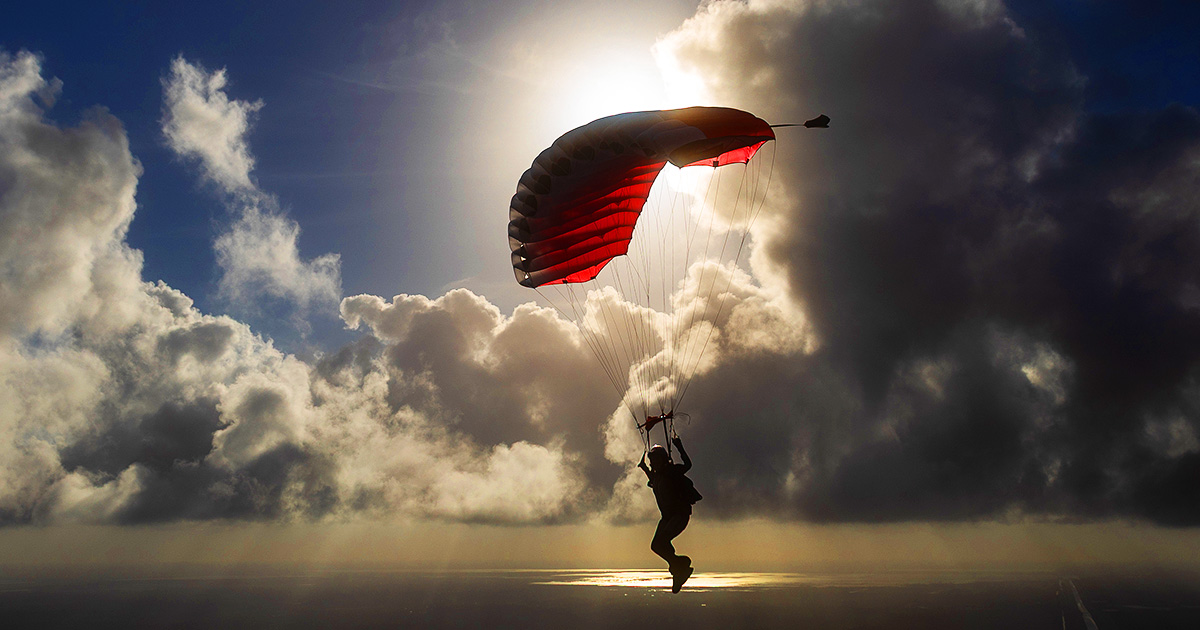
Photo by Anatoly Yuntsevich.
Situational Awareness and Spatial Anticipation
Another key benefit of visualization in skydiving is improved spatial awareness. Unlike many sports played on a defined surface, skydiving takes place in open airspace where athletes must constantly track their relative position to others.
Mental rehearsal helps skydivers anticipate:
- Positions of other flyers
- Fall-rate adjustments
- Tracking directions during break-off
- Horizontal and vertical separation
- Canopy traffic patterns
By mentally mapping these scenarios beforehand, skydivers can improve reaction time and problem-solving ability. And while risk can’t be eliminated, it can be significantly reduced.
A Variety of Applications
Mental training can benefit almost every role within the skydiving community—not just highly trained competitors seeking to perform under pressure. For example, every fun jumper must learn to manage fear. One way to do so is by prioritizing preparedness before the skydive even begins. Instructors and coaches often work with new skydivers who are just starting to learn to manage that fear. They can be an example for those students to follow.
Any skydive can result in an emergency situation, and remaining calm during a malfunction, cutaway, aircraft emergency or other unexpected predicament is critical. Mental preparation and visualization can aid a jumper in navigating these situations as efficiently and confidently as possible.
Skydiving demands physical skill, but it also requires clarity of mind, situational awareness and calm decision-making under pressure. Skydiving is one of the most exhilarating sports in the world. Just as skydivers train their bodies and refine their technical skills, they should also train their minds. Because sometimes the most important equipment you bring to altitude isn’t in your gear bag—it’s in your head.
About the Author
Pancho Campo, D-44392, is a former ATP tennis professional and Olympic tennis captain who now works in mental performance training. With more than 500 skydives across 20+ drop zones, he has experience in elite sport and adventure disciplines. Campo and his team developed the SMILE program—Sports, Motivation, Inspiration, Leadership and Energy—to help skydivers and other athletes manage fear, stress and performance pressure.