Above: Photo by Norman Kent.
At 8:31 a.m. local time on November 22, 104 skydivers at Jump Florida Skydiving in Lake Wales connected in a diamond to form the largest canopy formation ever, breaking the record of 100 that had stood for 18 years. The record event ran for two weeks, incrementally increasing in size over several days. By the second week, over a hundred skydivers gathered at the hangar at 5:30 every morning to review weather conditions and walk final dirt dives before gathering gear.
Chris Gay, who flew as “air-traffic controller,” directing each group’s approaches in real time over radio; Brian Pangburn, who also piloted the formation; and Kirk VanZandt, who oversaw dock grading and radio communications and engineered the bail-out oxygen system, were the primary organizers. They had the support of additional organizers Sarah Bromley, Andrew Draminski, Eric Gallan, Travis Johnson, Scott Lazarus, Yuliya Pangburn and Joe Thompson.
Planes fired up before sunrise and loaded in the dark, targeting the calm early-morning air for the healthiest builds. The formation engineering had the largest canopies toward the top and smallest toward the bottom for performance. Wing size, weight and position determined the composition of each group. Each jumper’s slot determined both their exit order, as well as what they wore, to optimize the stability and health of the formation.
Top and centerline groups huddled together wearing low-drag, slick attire—many sporting colorful, metallic bodysuits in fitted stretchy polyester. By contrast, groups flying at the outside edges and bottom point wore high-drag, baggy clothing: fuzzy onesies, printed pajama pants and oversized fleeces. Regardless of group assignment, however, the majority of the formation wore fitted cold-temperature base layers or thermals underneath, braced for performing effectively in the below-freezing temperatures at altitude.
Planes taxied through the darkness, runway lights flickering through windows fogged with condensation, as each waited their turn for takeoff into the early morning fog. They climbed slowly in formation and then held at staggered altitudes as the lead plane circled until the moment there was enough sunlight for exit, called out by Brian Pangburn over radio across the planes.
The formation required eight aircraft, with the first plane dropping the nine “big-boy elephant squadron” jumpers, who trained to build the 9-way base in about 90 seconds. All this from an altitude of up to 20,000 feet and into sub-zero-Fahrenheit temperatures. From there, subsequent planes dropped the next rows of jumpers from gradually lower altitudes, with the final three aircraft dropping the last jumpers from roughly 12,000 feet, matching the descent of the formation as it built, flying a jump run just above the build’s line of flight. The first five planes required oxygen support, with the lead-plane jumpers wearing bail-out oxygen systems.
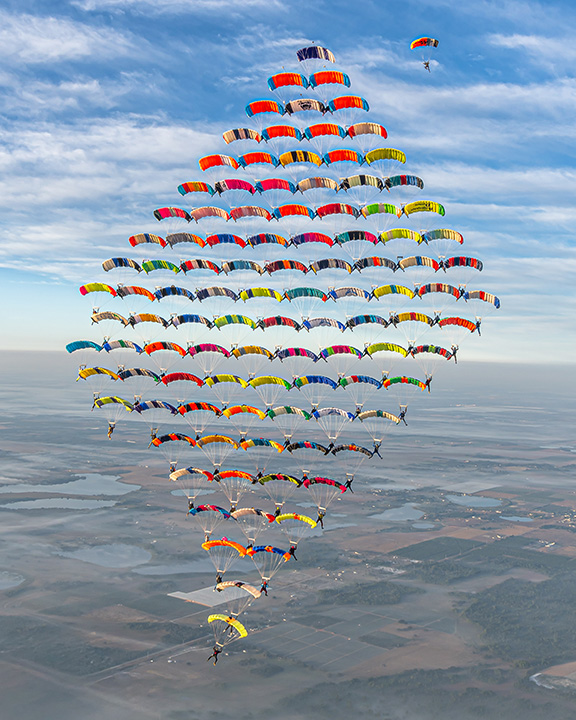
Photo by Michael Tomaselli.
The formation took approximately 11 minutes and 15 seconds to build, with each individual docking their canopy in an average of 6 seconds, and they held it for about 20 seconds once complete. Gay called the rows (diagonal lines of jumpers) into their holding positions alongside the formation, and then in to dock, while flying behind the formation until it was nearly complete, then docking himself. Once built, the formation was nearly 300 feet tall and 175 feet wide—roughly the height of a 25-story building. It weighed over 20,000 pounds of combined jumper exit weight, with Miami air-traffic control giving them 8-by-20 miles of clear air space. To ensure the team’s safety, the first jumper wore a ParaTrax ADS-B Out transponder to report their formation to ATC and ensure other aircraft maintained proper distance from the skydivers.
Conversations about this world record project had been ongoing since the last record in 2007, with the sequential (dynamic and multi-point) canopy formation world records over the last few years providing notable forward traction. The progress to this year’s goal included seven official training and selection camps during the 2025 season, spread across the U.S., Canada and Europe, that hosted hundreds of canopy-formation jumpers. During these camps, participants received grades on performance, dock stability, height, approach, split timing and overall quality and canopy control. VanZandt spent approximately 70 hours meticulously reviewing 130 scored jumps of 186 total jumpers trying to earn their spots for the world record, totaling roughly 4,000 docks, not including countless follow-up emails and guidance with participants. Pangburn and Gay provided additional review before confirming the final results, and participants received individual world-record invitations on the basis of their scores.
“This new world record is testament to the uprising in CRW [canopy relative work] over the last few years. Our 2007 record took us five years to train and practice for, and for this new record we actually only had training camps the last couple of years,” said Pangburn.
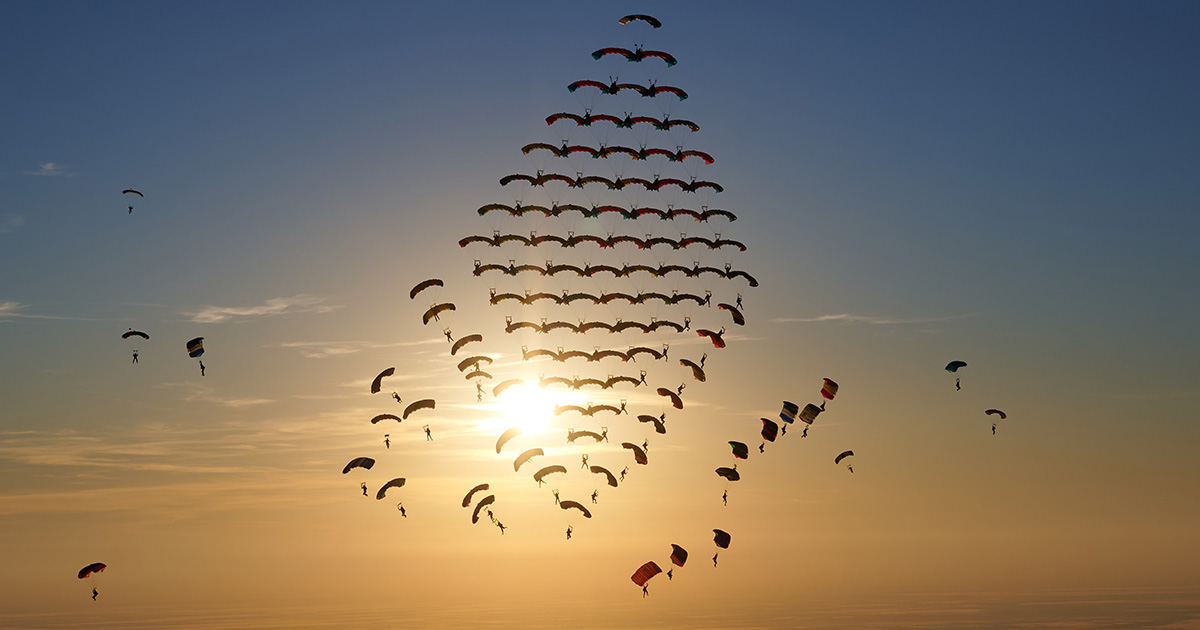
Photo by Gustavo Cabana.
The “CRW Dogs” who attended the event came from 17 countries around the world: Argentina, Australia, Belgium, Brazil, Canada, the Czech Republic, Denmark, Egypt, Estonia, Finland, France, Germany, the Netherlands, Poland, Sweden, the United Kingdom and the United States. Jumpers collectively traveled a total of nearly 300,000 miles. In total, the world-record team had over 548,000 canopy-formation jumps, averaging roughly 4,500 per participant, with four individuals boasting over 20,000 CF jumps each. There were three father-son pairs in the group: Frank and Dom Matrone, Casey and Colton Berg, and Pasi and Matti Pirttikoski.
The primary record videographer was Cat Isgrigg, whose indispensable task was to clearly capture every dock in order to allow Fédération Aéronautique Internationale (World Air Sports Federation) judges to verify all 187 legal grips. Bruno Brokken, Gustavo Cabana, Matt Faivre, Daniel Lepôt, Norman Kent and Michael Tomaselli provided additional video, while Wijnanda van Wijngaarden-van Der Vaart and Ben Rivet provided media support from the ground.
Performance Designs and Sun Path supported the project with repairs, research and development and miscellaneous equipment, while Rusty Vest repeated his 2007 role in overseeing the inspection and databasing of over 140 potential PD Lightning canopies on the record, alongside Dawn Hillebrandt and Andi Paulsen.
A key element of the project’s success was individuals not only fine-tuning their own performance, but developing a team mentality with their row members and plane groups. Organizers gave specific consideration to the order of row jumpers and the assignments of the row-leader “wings” (the jumpers guiding each incremental group in to dock), as these individuals were expected to not only dock proficiently and fly a competent approach, but also offer guidance and stewardship to those following. The result was several microcosms of trust, structure and performance that bolstered the overall group’s ability to turn 104 individual skydivers into one record-setting team.
Krista Goral D-41399
Charlotte, North Carolina