In skydiving, most problems start long before anything goes wrong. They begin when familiar habits replace deliberate technique, when small deviations slip by unchecked and when “good enough” becomes an unspoken standard. Normalizing excellence is a straightforward idea with big consequences for safety. The goal is simple—move beyond preventing errors and toward building a culture where exceptional performance is expected, repeatable and reinforced.
Let’s break this down into three pillars that enable excellence to take root: proficiency, accountability and facing the facts. The first pillar is proficiency—not just knowing what to do, but performing it consistently, deliberately and correctly.
Pillar 1: Proficiency
Reinforcing the Fundamentals
In a recent tandem video, the videographer is looking down on the instructor’s back rather than flying on level with the pair. The videographer did not appear careless or reckless. They appeared comfortable. Familiar. Confident. But proficiency isn’t comfort or familiarity—it is about performing correctly under changing conditions.
Though the video is not dramatic and shows nothing catastrophic, it reveals a serious proficiency issue with the videographer’s performance. If the tandem pair were to experience a premature deployment or other issue, they would likely strike or entangle with a videographer who is above them, increasing the risk of severe injury or death for everyone on the jump. The tandem equipment manufacturer’s manual is clear: “Never pass directly over or under the tandem pair during exit, drogue fall or deployment.”
A skilled tandem videographer must remain level throughout the strong acceleration during the exit, the rapid transition into the relative wind and the abrupt deceleration when the drogue inflates. Holding level and clear through that transition requires training, awareness and deliberate technique. When a jumper thinks “this is fine” simply because nothing went wrong, proficiency has quietly given way to familiarity.
In this example, normalizing excellence for the videographer means reaffirming that:
♦ “On level” means level with the tandem pair in the relative wind—not the horizon
♦ Clear airspace around drogue deployment is non-negotiable
♦ Getting the shot is secondary to safe positioning
♦ Being current is not the same thing as being proficient
A proficient videographer reviews their own footage, asks for feedback, revisits manuals and procedures and seeks coaching even after years in the sport. Proficiency is not about how often somebody has done something; it’s about how well—and how intentionally—they do it now.
Remember, complacency doesn’t announce itself; it arrives disguised as routine. Excellence is not about catching mistakes. It’s about preventing them—by reinforcing the fundamentals until they are second nature.
Pillar 2: Accountability
Excellence is a Team Standard
While proficiency is personal, accountability is shared. To normalize excellence, it’s not just individuals who need to do better. Those who are watching and teaching must not allow substandard performances to slide by unchallenged. We don’t operate in a vacuum. At every drop zone, there are instructors, coaches, Safety and Training Advisors, riggers and staff who all play a role in setting expectations and giving feedback. When a videographer consistently exits too high, gets too close to the drogue or breaks basic procedures outlined in the manual, the issue isn’t just their flying—it’s the community’s silence.
Accountability means we notice, we speak and we correct. It means that we hold ourselves responsible not only for our own performance but for upholding the safety standards around us.
Correction Is Not Criticism
It can be tough to hold someone accountable—especially when no one’s been hurt. Just remember, accountability isn’t about criticism—it’s about care. It’s a sign that we value safety more than comfort and outcomes more than optics.
In the case of the videographer, asking them to retrain or grounding them is not personal, it’s professional. It protects the tandem pair, the videographer and the integrity of the drop zone’s safety culture. And it signals to others that standards still matter. Normalizing excellence means enforcing minimums.
So, who is responsible for the camera flyer’s performance?
♦ The camera flyer is responsible for reviewing their own work and seeking coaching when they’re unsure.
♦ The instructor is responsible for giving feedback on exit performance and calling out unsafe positioning.
♦ The S&TA is responsible for reinforcing procedural expectations and investigating deviations.
♦ The drop zone operator is responsible for creating an environment where safety standards are visible, supported, and enforced—even when it costs time or money.
In short, we are all responsible.
Excellence doesn’t happen through individual mastery alone. It happens when a culture develops where excellence is expected, taught and supported. And culture doesn’t shift by accident—it shifts when leaders at every level decide that close enough isn’t good enough.
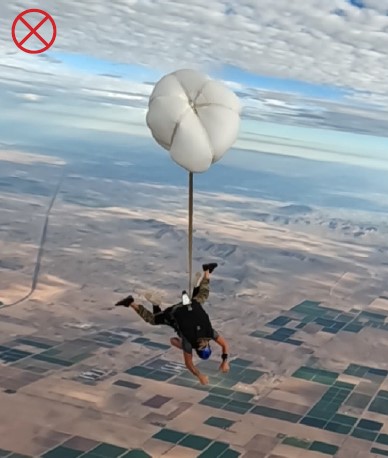
The videographer is above level and too close to the drogue, which creates a safety risk. Close proximity is only acceptable when the videographer is on level with the tandem pair.
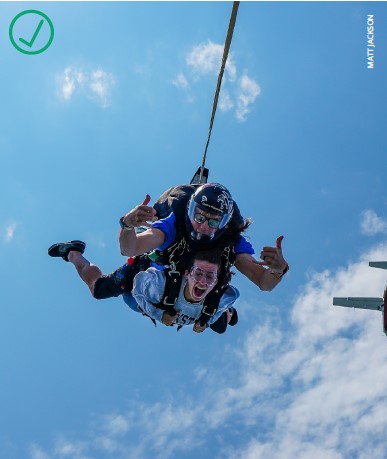
The videographer taking this shot is on the correct level and stayed with the tandem pair throughout the exit.
Pillar 3: Facing the Facts
What We Tolerate, We Teach
When a videographer consistently exits too high—or anyone else violates safety standards—it’s not just poor form; it’s a known hazard. A hazard that, under the wrong conditions, could be fatal. So, as a community, we need to stop pretending that something is acceptable when it’s not. Choosing to ignore a risk just to avoid confrontation is laying the groundwork for the next incident.
Just Because Nothing Happened ...
Every rule, every procedure and every standard in our sport was created in response to a near miss, injury or fatality. When we violate those standards—or allow them to be violated—we’re not bending guidelines. We’re forgetting what they were built to prevent. There’s a reason that the phrase “the Basic Safety Requirements are written in blood” exists in our sport.
Facing the facts requires watching the performance of those around us, recognizing patterns of behavior and asking the hard questions:
♦ Is this safe, or is it just familiar?
♦ Is this how we want jumps to be made or is it how we’ve let them become?
♦ Are we protecting jumpers or just preserving comfort?
When we stop answering those questions honestly, we stop leading.
Here’s the truth: An incident does not need to occur for there to be a problem. Unsafe exits, poor positioning, inadequate supervision—these are already problems. They don’t become real just because something goes wrong. They’re real now.
Facing the facts means refusing to wait for a close call to justify action. It means calling something unsafe before it creates a headline. It means retraining someone who’s “been doing it that way for years.” It means choosing leadership over popularity.
The Path Forward
No matter what your role in the sport, the pillars of proficiency, accountability and facing the facts apply. Take a moment to apply them to yourself and the jumps you do. For example, do you consistently review and rehearse your emergency procedures or do you assume the training you received as a student was good enough? Do you land from a zoo dive and assume everything was fine just because no one was hurt?
This Safety Day, we’re celebrating 30 years of raising awareness—and raising the bar. Normalizing excellence isn’t about setting impossibly high standards. It’s about refusing to pretend that “good enough” is actually good enough. Proficiency is how we build skill. Accountability is how we support each other. Facing the facts is how we stay honest and ahead of preventable outcomes.
The next time you see something that isn’t quite right—on video, in a debrief or on the manifest sheet—don’t wait for something to go wrong. Say something. Change something. Normalize excellence.