Photo by Scott Harper.
It’s an exciting feeling, being fresh off student status, and the possibilities of what might come next seem endless. Whatever the discipline you want to dive into, it’s important to remember that grabbing a few friends of varying skill levels and making a bunch of jumps won’t make you an expert. While this can be fun, it can also reinforce incorrect techniques and bad habits. If you want to become proficient in a particular discipline, you need a plan of action, time, patience and the gumption to stick to it. With a little discipline and persistence, you can get the most out of your training skydives and shorten the learning curve in the process. Here are some tips that can help.
Get Coached
There is nothing better at accelerating the learning process (especially when you’re new to the sport) than a good coach. Depending on your budget, coaching can be as simple as seeking advice from a trusted experienced skydiver or as sophisticated as going to a tunnel camp. Hiring a coach is a reflection of serious commitment. The more committed you are—whether as a team or individual—the more essential it becomes to have expert guidance.
The words of world-champion skydiver and load organizer Dan Brodsky-Chenfeld couldn’t be more true: “A team is whatever you want it to be.” Coaching is especially important for teams because it’s not just one person learning a new skill; everybody on the team must learn something new while learning to work as a cohesive, synchronous unit. For example, block moves in 4-way involve the pieces working together—and each jumper within a piece working with their partner—to make the piece move efficiently. There are lots of moving parts. By hiring a coach, each jumper can focus on their job with fewer distractions.
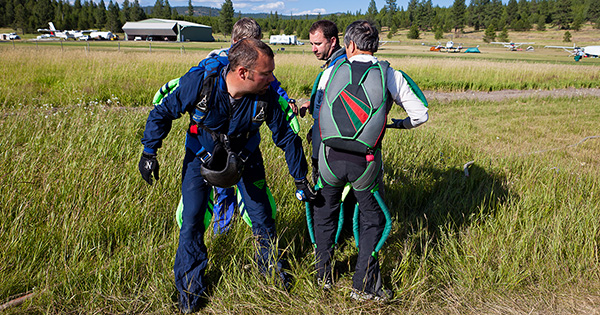
Photo by Chad Wilcox.
Practice Hard
Author and journalist Malcolm Gladwell says the most successful hockey players, computer programmers and musicians have all practiced 10,000 hours or more. This seems almost impossible when it comes to skydiving, but top teams like Arizona Airspeed put in hundreds of hours training through tunnel time, visualization, creeping, debriefing, dirt diving and actual air time. One quote by Gladwell sticks out: “Practice isn’t the thing you do once you’re good. It’s the thing you do that makes you good.”
Another author, Josh Kaufman, in “The First 20 Hours: How to Learn Anything Fast,” says this: “I field-tested the practice methods I explain in ‘The First 20 Hours’ on a wide variety of skills in several contexts: fine and gross motor movements, cognitive processing, personal hobbies and professional skills. In each instance, I noticed the most dramatic improvements during the first 20 hours of practice.” This is good news for weekend jumpers who want to challenge themselves but don’t have a lot of extra time during the week to train.
One thing seems common in both Gladwell’s and Kaufman’s research—there were likely no large gaps of time in peoples’ training. Whether they actually liked what they were learning is unclear, but they stuck with it. They were consistent. The best results come from regular practice, and skydiving is no exception.
Set Specific Goals
There are only so many new things you can remember on each skydive. If your overall goal is to dock softly on a small formation, you need to break that down into smaller goals (or skills) and then work on just one skill at a time. When learning to efficiently dock on a formation, one of your first goals may be to not go low. To master this, you could practice coming out of your dive high enough for you to completely stop at around 12 feet up and five feet out from your slot. Whether you dock on the formation or not, it doesn’t matter. What matters is that you set a goal to stop in a specific spot and you did it! If you weren’t able to stop where you needed to be on this skydive, then set the same goal for the next skydive. In fact, it’s a good idea to practice the same skill on two or more consecutive skydives, which builds confidence and improves muscle memory. Muscle memory is what allows you to perform a skill without having to think so much about it—your moves become automatic.
Once you have successfully accomplished a goal, you can add a new one to the next skydive. Let’s continue with the previous example, where you had successfully stopped 12 feet above and five feet out from your slot. Your goal on the next couple skydives could be slowly inching your way down and forward toward your slot and then stopping a foot above and a couple feet out. Again, don’t worry about docking. Getting closer to your slot is your goal and mastering that skill will help you conquer your goal of softly docking.
Each time you add a goal, you are building on what you’ve already learned. Don’t get overwhelmed trying to remember all of it—you’re just adding one more goal to what you’ve already learned. A good way to do this is to visualize the entire skydive from the time you leave the plane until you land. This is called your “dive plan,” and it’s not as complicated as it sounds. You’re simply reinforcing what you’ve already learned without overwhelming your brain with a lot of new information. Visualize several times on the ground and a few times in the plane. On jump run, breathe and remind yourself that you’ve got this!
This article can’t provide everything you need to know to become a safe, confident and proficient skydiver. For one, it hasn’t mentioned canopy safety, something you must practice on each and every skydive. Even if your skills are good enough to get you invited onto the hot loads, nothing will get you booted off the next one faster than a dangerous maneuver under canopy that puts other jumpers at risk. So, while you’re visualizing the perfect skydive, be sure to include your duties under canopy in your dive plan. It’s great to train hard and play hard, but it’s even more important to put safety first and ego last. If you do that, you will have a long and happy skydiving career.
 About the Author
Ed Lightle, D-5966, is a long-time 4-way enthusiast and big-way record holder with over 4,400 jumps. He has written many articles on formation skydiving for Parachutist magazine and continues to share his passion for the sport with jumpers of all ages and experience levels.