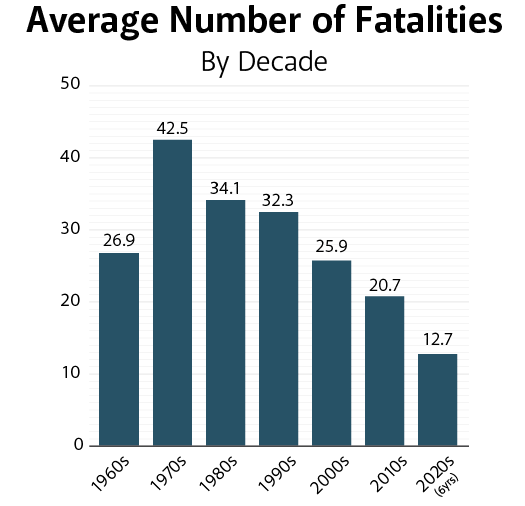
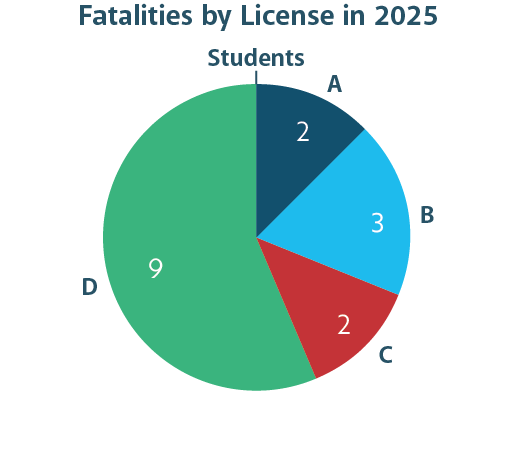
After several years of declining annual fatality totals in the United States, when the ball dropped at the close of 2025, it finished with a disappointing 16 civilian skydiving deaths. While that number seems high compared to the previous year, when fatalities reached an all-time low of just nine deaths, the safety trends in skydiving are still moving in the right direction. Compared to the previous decades, 16 is still a relatively low number. Beginning in 2018, the annual totals began to drop significantly. However, spikes and fluctuations are a frustrating reality of the sport when it comes to tracking this data.
Every fatality is a tragedy that leaves friends and family with unimaginable sadness and feelings of loss. When you engage in a sport with such a high penalty for mistakes and errors in judgment, it is imperative that you do everything possible to mitigate those risks to stay as safe as possible. Most of the time, the key to safe skydiving is sticking to the basics. Master new skills slowly with plenty of practice and supervision. Stay conservative with your parachute advancement and remain vigilant while under canopy on every jump from deployment all the way to your landing. Have a plan for every skydive that includes the exit, freefall, deployment altitude and your descent under the parachute. And practice your emergency procedures frequently and thoroughly.
The fatality index is a measure of fatalities per 100,000 skydives that helps determine whether safety is improving or worsening using a standard metric. At its worst in 1961, the fatality rate was 11 deaths per 100,000 skydives. Compare that with last year, when the rate was 0.46 fatalities per 100,000 skydives. Incredibly, the skydivers in 1961 were 22 times more likely to die during a skydive than jumpers today. While that is an impressive improvement in safety, that’s not much comfort for those 16 families.
This annual report examines the details of each fatality and organizes them into categories based on what happened during each skydive. Comparing those categories over time helps the Safety and Training Committee and the Director of Safety and Training identify trends, enabling USPA to determine where to focus efforts to improve safety and educate the membership on how to avoid those same mistakes. Each category includes the year’s number along with its percentage of the total, followed by the percentage for the last 20-year period for comparison.
Landing Problems 4: 25% (2006-2025: 34.4%)
This category is made up of three sub-categories: Intentional Low Turns, Unintentional Low Turns, and Non-Turn-Related landing fatalities. Each subcategory has more specific details that require different approaches towards safety and education to address them properly.
Intentional Low Turn: 4: 25% (2006-2025: 34.4%)
When a jumper purposely initiates a turn at a low altitude to build speed for a high-performance landing and makes a fatal mistake, the death falls into the Intentional Low Turn category. Jumpers in this category are typically either highly skilled and experienced, or moderately experienced but lacking the necessary skills, often having downsized rapidly to a smaller parachute.
- A 47-year-old male with 25,782 jumps and 24 years of experience exited a Twin Otter at 6,500 feet for a solo high-performance landing over a swoop pond. Investigators reported that this was likely his first jump following several months of inactivity. He was jumping a 57-square-foot, cross-braced canopy and was wearing a weight belt to increase his wing loading to 3.6:1. His exit, deployment and initial descent were all uneventful. He initiated three 360° rotations (a 1,080° turn) to build speed for his intended landing. The altitude at which he initiated the turn was not reported, but witnesses on the ground observed him finish the final 360° turn at much too low of an altitude to recover to straight-and-level flight for the landing. He struck the ground at a high rate of descent approximately 300 feet short of the swoop pond and traveled another 280 feet before coming to a stop just short of the water. He received immediate medical attention but died at the scene.
Postmortem toxicology detected delta-9 THC measured at 4.7 ng/mL in blood, along with its inactive metabolite. A quantitative blood result at this level is generally consistent with relatively recent cannabis use, as blood measurements reflect more recent exposure than urine testing. However, while these findings indicate recent use, they do not, by themselves, establish the presence or degree of impairment at the time of the skydive. No alcohol or other drugs were detected.
- A 42-year-old male with 1,520 jumps and 10 years of skydiving experience was practicing for an upcoming swooping competition and deployed his 79-square-foot, cross-braced canopy that he loaded at 2.3:1. The initial canopy descent was uneventful. He initiated a 450° turn for his final approach toward the swoop pond and struck it while in a steep descent, coming to a stop in the water. He received immediate first aid but was declared dead at the scene.
- A 58-year-old male with 1,297 jumps and eight years of skydiving experience was jumping a 94-square-foot, cross-braced canopy at a wing loading of 2.3:1. He made a turn to final approach reported only as “too low” and struck the ground while still in a steep descent. He received immediate first aid but died from his injuries during surgery later that day.
What This Can Teach Us
The advancement of parachute technology over the last 40 years has been nothing short of remarkable. Skydivers are now flying and landing parachutes one-quarter the size of what was possible in 1985. However, it takes nearly perfect precision to manage flight under these highly loaded, smaller wings that have faster forward speeds and steeper descent angles. Just leaning in the harness can create a significant diving turn. A mistake made while landing a larger parachute flying a straight-in approach usually leads to a few bruises or a sprained or broken ankle. But the usual penalty for a landing error under a small, fast parachute is either severe, life-altering injury or death. The skydiving industry has made strides in canopy training and education, which is helping reduce the number of canopy-related accidents, but speed-inducing turns for high-performance landings continue to cause injuries and fatalities each year. For those who choose to pursue high-performance parachute landings, ask yourself if the greatly increased risks of injury or death are worth the rewards.
Following a long layoff, easing back into high-performance flight with conservative landings is a better choice than making a big move with a lot of rotation on your first jump in several months. Even for those jumpers with a lot of experience.
If a jumper initiates a turn too low, a safe landing is usually still possible if the jumper aborts the turn high enough. It requires excellent depth perception to recognize when the altitude is too low and the setup for the landing is wrong and then rapid decision-making skills to recover the parachute to straight-and-level flight and flare for landing. Target fixation or focusing too much on the entry gates onto a competition canopy course might be enough of a distraction to misjudge the altitude necessary to fly the parachute through the recovery arc. Even competitors with a lot of experience can fall into the trap of trying to force a turn to work when the setup is wrong.
Landing any parachute well requires a proficient level of hand-eye coordination, a lot of careful practice and a significant amount of skill. Students and novice skydivers use larger, more docile parachutes to provide slower forward speeds and descent rates to protect against injuries after the inevitable mistakes that crop up while learning the landing basics. The essential skills of depth perception and hand-eye coordination become more important as skydivers move toward jumping smaller and faster parachutes. The faster you go, the faster everything happens. It doesn’t take much to get behind the curve on a high-performance landing. And behind the curve as the ground is rapidly approaching is a dangerous place to be.
Two of these jumpers were jumping sub-100-square-foot parachutes loaded at 2.3:1 although they had made relatively few jumps for their number of years in the sport, meaning that they made a low number of jumps each year. Jumping parachutes at this wing loading requires a high level of skill, proficiency and currency. Rapid downsizing and infrequent jumping are two factors that greatly increase the chances of making a fatal mistake when the speeds and descent rates increase.
Skydiving while under the influence of drugs or alcohol is never a good idea, and it is against Federal Aviation Administration regulations. Slowed reactions, impaired vision and similar effects do not mix well with skydiving.
Unintentional Low Turn 1: 6.3% (2006-2025: 6.8%)
When a jumper dies while making a low turn close to the ground but did not initially plan to turn, the fatality falls into the Unintentional Low Turn category. Jumpers in this category typically have a low experience level and attempt to make a last-second turn to avoid a jumper under canopy, avoid an obstacle on the ground or face into the wind for landing.
- A 28-year-old male with 220 jumps and two years of skydiving experience was flying his 190-square-foot parachute loaded at 1.3:1 while making his first jump at this drop zone. Winds were light and variable. After the airplane took off, the winds shifted 180 degrees, making the landing direction opposite that of what those on the load had discussed and planned before the jump. His exit, freefall and initial parachute descent were uneventful. On his final leg of the landing pattern, this jumper made a turn reported only as “too low” in an apparent effort to land in the same direction as the others. He struck the ground in a diving turn without flaring. He received immediate medical attention but died at the scene.
What This Can Teach Us
Light and variable winds can be challenging, making choosing a landing direction confusing and even dangerous. This jumper elected to make a last-second turn to land in the same direction as the parachutes landing before him, but it would have been safer to continue flying the parachute in a straight direction, making only slight corrections to avoid obstacles or other parachutes.
The canopy-flight training this jumper received was not reported, but most parachute manufacturers consider 1.3:1 to be an advanced wing loading. This jumper probably did not realize how much altitude this parachute would lose while making a turn so close to the ground. USPA has developed canopy training and education within the Integrated Student Program in Chapter 1 of the Skydiver’s Information Manual. There are additional canopy training and exercises, found in SIM Chapter 5, as part of the B-license requirements. USPA developed this training and education specifically to help jumpers avoid these types of landing errors.
At most drop zones, the first jumper down sets the landing direction for the load. However, when winds are light and variable, it is probably safer to select the best landing direction for the conditions before each load and stick with that direction, even when the windsock has shifted.
Non-Turn-Related 0: 0% (2006-2025: 10.3%)
When a jumper dies while trying to land a parachute but the incident is not turn-related, the fatality is recorded in the Non-Turn-Related category. A fatality in this category might stem from a jumper landing in water and drowning or striking the side of a building or other obstacle on the ground.
There were no fatalities in this category in 2025.
Canopy Collision 2: 12.5% (2006-2025: 11.7%)
When two jumpers collide while under their parachutes and this results in a fatality, it is recorded in this category. Canopy collisions most commonly occur either right after deployment (due to inadequate separation from other deploying jumpers) or in the landing pattern below 1,000 feet (usually close to the intersection of the base and final legs).
- A 48-year-old female with 163 jumps and six years of experience exited a PAC-750 for a 3-way formation skydive from 14,000 feet. The exit, freefall and initial parachute descent under her 189-square-foot parachute at a 0.9:1 wing loading were uneventful. Investigators reported that this jumper entered the landing pattern in the opposite direction of the established traffic pattern. It was reported that this jumper had flown incorrect landing patterns and exhibited confusion about landing direction in the past, and she had been counseled about this.
Another jumper turned to begin the downwind leg of his landing pattern, and the two jumpers were now flying directly toward each other. Both jumpers turned to avoid one another, but the parachutes made contact and briefly entangled. After the collision, both parachutes partially collapsed and spun, but they then separated and reinflated. Both main parachutes sustained minor damage from line burns but did not have any broken lines or major damage that would have prevented normal parachute operation.
At approximately 400 feet, this jumper released her main parachute and pulled the reserve ripcord. The reserve static line (RSL) was properly connected before deployment. Based on the evidence, it appears the canopy collision compromised the RSL system. Under the stress of the cutaway, the RSL released rather than the typical sequence of being extracted with the departing main canopy. The RSL remained with the jumper, indicating it separated under the load instead of being pulled free by the main risers. There were no visible signs of damage that clearly identified how the collision compromised the system. Whether the separation occurred before or after the reserve pin was extracted cannot be determined from the available information. It was unreported whether there was any delay after the cutaway, but the reserve had only enough time to clear the freebag and did not fully inflate before she struck the ground. She was declared dead at the scene. The other jumper landed without further incident.
- A 40-year-old male with 2,900 jumps and 10 years of experience was participating in a 10-way high-performance-canopy-flight skills camp, jumping from a Cessna Caravan with deployments at 13,000 feet. He was using a 75-square-foot, cross-braced parachute at a wing loading of 2.9:1, and his container was not equipped with an RSL. The jumpers split into two groups of five each, planning to fly toward each other in lines with one group flying barrel rolls over the other group as they passed by each other.
This jumper, who was in the group performing barrel rolls, was the second canopy pilot in his line. He collided during his barrel roll with the third jumper in the opposing line, who was flying level. The impact sheared the lines off the canopy of the jumper who was flying level, and he immediately released what was left of his main canopy and risers and deployed his reserve, landing uneventfully.
Investigators reported that this jumper was most likely severely injured in the collision, causing him to drift in and out of consciousness. He descended for several thousand feet under his spinning main parachute before he pulled the reserve ripcord and deployed his 113-square-foot reserve, which he loaded at 2.0:1. He deployed the reserve while he was unstable and either entangled with the parachute lines or the reserve inflated with uneven risers and line twists, forcing the reserve into a spin. The spinning malfunction continued until he fatally struck a building on landing.
What This Can Teach Us
Every skydive begins with a plan for the exit, freefall, deployment, parachute descent and landing pattern. It is critical that all jumpers on the same load fly an established landing pattern to facilitate a safe flow of canopy traffic.
Panic can cause jumpers to initiate emergency procedures even though they are well below the hard deck for a safe cutaway. SIM Chapter 4-1 recommends that below 1,000 feet, jumpers should deploy the reserve without cutting away and land with both parachutes.
A connected RSL ensures faster reserve activation than jumper reflexes alone. A main-assisted-reserve-deployment device (MARD device) ensures an even faster deployment than an RSL. Reserve activations via an RSL or MARD have proven to be extremely reliable, even under spinning main parachutes with high wing loadings.
 High-performance canopy flocking events are becoming more commonplace as they gain in popularity. It is critical that the flights planned can be executed safely and provide a margin of error in case the formations don’t go as intended. Pushing the limits of high-performance parachute flight comes with great risks.
Reserve parachute malfunctions are rare and are almost always caused by an unstable body position or tumbling during deployment.
The size of your reserve parachute is an important choice. Very highly loaded reserves are more likely to spin, and anything less than a perfectly flared landing could result in an injury or fatality. Some manufacturers will make containers that accommodate a reserve that is relatively larger than the main. The extra square footage just might mean the difference between surviving a landing or not.
No Pull 3: 18.8% (2006-2025: 4.9%)
When a jumper exits an airplane and fails to deploy a main or reserve parachute, the fatality falls into this category. In the early years of sport parachuting this was a significant percentage of the total each year. The advent of reliable automatic activation devices (AADs) and higher main deployment altitudes has greatly reduced the number of fatal accidents in this category. The last occurrence of a fatality in this category was 10 years ago, in 2015.
- A 76-year-old jumper with 1,035 jumps and 32 years of experience exited a Twin Otter for a solo skydive at 13,000 feet. He continued in freefall until he struck the ground without deploying a main or reserve parachute. His container was not equipped with an AAD. Investigators reported that he was found face down with his right arm back toward his main-pilot-chute handle, but the pilot chute was still in its bottom-of-container pouch, and the cutaway and reserve ripcord handles were in place on the parachute harness. There were no medical problems discovered in the autopsy.
- A 45-year-old jumper with more than 200 jumps and seven years of experience exited a Twin Otter at 13,000 feet for a solo wingsuit jump. This was his first wingsuit jump since completing a first-wingsuit-flight course a few weeks prior. A tandem instructor on the same load under canopy at approximately 4,000 feet reported seeing this jumper still in freefall and spinning in a back-to-earth orientation. He continued in freefall and struck the ground without deploying a main or reserve parachute. The hard impact killed him instantly. Investigators reported that he was found with the cutaway handle pulled and approximately five feet away, but the main pilot chute and reserve ripcord handles were both still in place. The AAD, which was not reported to be a wingsuit-specific model, showed a black square on the display window and investigators could not determine whether it was damaged from the impact or had not been turned on before the skydive.
- A 76-year-old jumper with 230 jumps and 29 years of experience exited a Twin Otter at 12,500 feet for a solo skydive. Following a long absence from the sport, he had completed refresher training and a currency jump with an instructor earlier the same day. Witnesses on the ground observed him in a stable freefall position until he struck the ground. He did not appear to make any attempts to open his main or reserve parachute. The hard impact killed him instantly. His AAD had activated at some point, however the reserve pilot chute did not deploy until impact.
What This Can Teach Us
Altitude awareness is critical for every skydive, especially when you encounter a problem. If you are unable to locate or pull your main deployment handle, you should immediately pull your reserve ripcord to activate your reserve.
As we age, flexibility becomes an issue. What might seem like an easy reach to grab a bottom-of-container-mounted pilot chute can be a challenge for older jumpers.
In the last three years, five wingsuit jumpers have died after experiencing instability and tumbling during freefall. Three had recently completed a first-wingsuit-flight course and two were relatively inexperienced with wingsuit flight. This seems to indicate that those jumpers who are teaching wingsuit flight need to place greater emphasis and practice for emergency procedures and recovery procedures for instability during freefall. SIM Chapter 5-8 covers wingsuit-flight recommendations, including procedures for out-of-control wingsuit flight.
Wingsuit flyers should be aware that non-wingsuit-specific AADs may not activate when the jumper is in a flat spin or in other types of wingsuit flight because the freefall speed may be too slow to meet activation parameters. Wingsuit-specific models of AADs that activate at slower freefall speeds experienced during wingsuit flight can help address this issue.
The limited information in two of these reports did not include any information regarding the AADs and whether there were failures of any components that might have prevented the reserve parachute from deploying at the designed altitude.
Freefall Collision 2: 12.5% (2006-2025: 2.7%)
When two jumpers collide in freefall and it results in a fatality, it is recorded in this category.
- A 47-year-old male with 2,136 jumps and five years of experience exited a Twin Otter at 13,000 feet as an outside videographer for a 13-way formation skydive, which was taking place at a skydiving boogie. Approximately 25 seconds after the exit, one of the other jumpers—who was reportedly not in control and unable to slow his descent—struck the videographer from behind while diving toward the formation. The impact incapacitated the videographer, who continued in freefall until his AAD activated his reserve. Investigators reported that he was observed limp in the harness under his reserve parachute until he reached the ground. He was found with the brakes still stowed and no handles pulled. First responders administered first aid, but he died at the scene shortly after landing. The other jumper deployed his main parachute after the collision and landed without any injuries.
- A 62-year-old male jumper with more than 5,300 jumps and 25 years of experience exited a Cessna Caravan at 14,000 feet with four other jumpers as part of a 5-way formation skydive. Just before breakoff there was vertical separation of approximately 10 feet between at least two of the jumpers. This jumper began to track away from the formation and collided with one of the other jumpers. His head and neck struck the other jumper in his hip area. The other jumper was uninjured from the collision and landed normally under his main parachute.
Following the collision, this jumper continued unresponsive in freefall. Ground witnesses observed him freefalling back to earth until his reserve parachute deployed at an altitude reported only as “very low.” After landing, he received immediate medical attention and a helicopter air-lifted him to a hospital. Medical personnel determined that he broke his neck in an area that caused him to have quadriplegia and that he would need a respirator to breathe. He elected to be removed from life support and died soon afterward.
What This Can Teach Us
Freefall collisions are quite common, but most occur with very little momentum and result in little more than a slight burble or lightly funneled formation. When closing speeds increase, the risk of injury or fatality also increases. Depending on the angle and speed of an impact, it takes very little force on the head and neck to cause a severe or fatal injury.
Skydiving boogies bring together jumpers of varied experience levels who may not be familiar with each other’s abilities. Skydives should be organized to allow jumpers with lower experience to advance to larger formations with a safe progression.
Equipment Problem 2: 12.5% (2006-2025: 12.5%)
When a jumper encounters a problem with their skydiving equipment that leads to a fatality, it falls into this category. The most common problems in this category stem from packing errors or poor maintenance and worn components.
- A 55-year-old female jumper with more than 280 jumps and four years of experience exited a Twin Otter at 13,000 feet for an unreported type of skydive. The exit, freefall and initial deployment of her 150-square-foot parachute with a wing loading of 1:1 were all uneventful. A jumper who exited in a group after her reported seeing her flying toward him under a fully inflated parachute as she was stowing the slider and releasing the brakes. At approximately 2,500 feet, he observed the tail of her parachute deflect slightly as she pulled both toggles to release the brakes. The parachute then began a turn to the right that continued for the remainder of the descent. The hard impact killed her instantly.
Investigators found the right steering toggle still inserted through its cat’s eye in the steering line, and the left steering line unstowed. The cat’s eye of the brake line was slightly worn with broken carriers in the cat’s eye, but not excessively tight on the steering toggle. The parachute system was in good condition and the cutaway and reserve-ripcord handles were both found in their stowed position, and both could be pulled without excessive force.
- A 60-year-old male jumper with 515 jumps and five years of experience made a solo wingsuit skydive. There were no witness reports for his exit, freefall or deployment. Witnesses on the ground reported seeing this jumper under a spinning main parachute from approximately 3,000 feet all the way to impact. He received immediate first aid, but he was declared dead at the scene. The cause of the spin was not reported.
What This Can Teach Us
If a steering toggle is stuck in the cat’s eye, it may be possible to free it by pulling on the toggle from different angles or sharply pulling the toggle with a fast, hard pull. If you cannot free the toggle before reaching your decision altitude, initiate emergency procedures and land with your reserve parachute.
Steering lines wear faster than the parachute suspension lines, and they should be replaced when exhibiting signs of wear, such as excessive shrinkage or fraying. A spinning parachute can quickly lead to disorientation. If one brake line is stuck in the stowed position, you can pull the other toggle down to the distance that matches the stowed setting to eliminate the spin. This can provide more time to evaluate the problem while the parachute flies in a straight direction.
Beginning with your first solo skydive, you are trained for emergency procedures in case your main parachute cannot be deployed or it malfunctions. Skydivers must be prepared to execute emergency procedures on every jump. SIM Chapter 4-1 covers recommendations for skydiving emergencies. Emergency procedures should be initiated no lower than 2,500 feet for students and A-license holders and no lower than 2,000 feet for B- and C-license holders. D-license holders should establish their decision altitude for themselves based on their experience and equipment.
Medical 2: 12.5% (2006-2025: 10.3%)
When a jumper dies from a heart attack or some other physiological incapacitation during a skydive, it falls into this category. Additionally, if a jumper commits suicide while skydiving, it is also placed into this category as it is the result of mental health issues.
- A 49-year-old male jumper with 35 jumps and one year of experience exited a Cessna Caravan at 13,000 feet for a solo skydive. Investigators reported that other jumpers in the air observed his main deployment and it appeared normal. Shortly afterward, he was observed at approximately 2,500 feet slumped in his harness and slowly spinning, which continued until he struck the ground with a hard impact. He received immediate medical attention, but he was pronounced dead at the scene. The right brake line was still in its stowed position after the landing, but the left brake line had been released. It could not be determined whether the jumper had released the brake or the brake line dislodged itself during deployment. His autopsy revealed that he died due to blunt-force trauma from the hard impact with the ground. However, the autopsy also determined that he had experienced a heart attack due to severe artery atherosclerosis with a 90% blockage of the right coronary artery.
- A 20-year-old male jumper with 65 jumps and two years of experience made a 3-way skydive with an uneventful exit, freefall, deployment and initial descent under the parachute. Another jumper under canopy at approximately 800 feet reported seeing this jumper below him at an unreported altitude under a normally flying parachute. He then witnessed this jumper pull his cutaway handle and release the main parachute. This jumper then went back into freefall, descending feet first into a wooded area. First responders found him soon afterward and attempted first aid. However, he was declared dead at the scene from the hard impact.
This jumper had received a gear check before the jump and his AAD was turned on and his reserve static line was connected properly. When investigators checked the gear on the ground, they found that the RSL had been disconnected. The cutaway was performed low enough that the AAD would not have enough time or altitude to re-arm and activate. It was also reported that he had previously expressed suicidal thoughts to a friend.
What This Can Teach Us
Skydiving places additional stress on the cardiovascular system. All skydivers experience an increased heart rate and adrenaline surge during a skydive. Most medical professionals recommend that people who are 40 or older see a medical professional for an annual physical exam. For those who have a family history of cardiovascular disease, additional medical testing might be required to help identify problems.
Death by suicide makes up approximately 3% of total annual deaths in the United States. So, it stands to reason that a skydiver will occasionally elect to end their life on a skydive. In the last 20 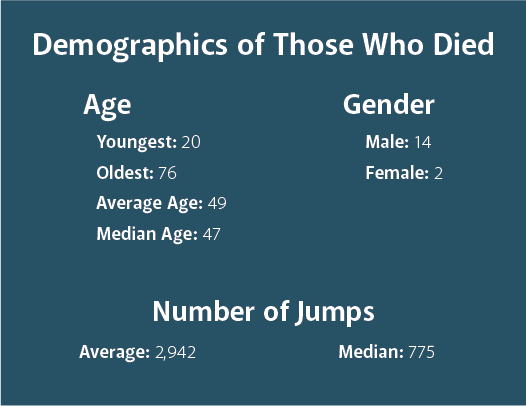 years, 10 skydivers have committed suicide during a skydive for an average of 2.7% of the total number of skydiving fatalities during that timeframe. If you know of someone who might be at risk, help is available through local and national resources. A call or text to 988 will connect you to health professionals who can help the individual at risk or provide guidance for a loved one. Unfortunately, sometimes there is no obvious sign that someone is at risk of suicide, and they are gone before there is any chance to provide help.
Entanglement -Airplane 1: 6.3% (2006-2025: 0.3%)
When a jumper is killed due to an entanglement with the airplane, it falls into this category. While there have been similar fatalities in other countries, this is the first time a fatality in this category has occurred in the United States.
- This jumper, a 35-year-old male tandem instructor with 5,700 jumps and nine years of experience was conducting a tandem skydive with a first-jump student from a Cessna 182 airplane. The instructor was very experienced with tandem jumps from larger jump planes, but he may not have had much experience conducting tandems from Cessna 182s.
The student’s harness was equipped with a “Y-mod,” a Y-shaped strap that prevents the student from slipping backward out of the harness. The Y-mod on this harness was improperly fitted. It was let out to the stop at the end of the strap, leaving the maximum amount of slack, which hung low from the student’s leg straps. The instructor did not carry a hook knife on this jump.
At 9,500 feet, the tandem pair began to climb out of the jump door onto the jump step above the landing gear for the exit. The student was improperly positioned low on the step, allowing the Y-mod to hang too close to the step. The instructor filmed the exit using a hand-mounted camera and used only one hand to push off the aircraft. Upon letting go, the tandem pair immediately became suspended upside down from the step by the Y-mod.
For several minutes, the instructor tried various ways to either resolve the entanglement or disconnect from the student’s harness, but these were in vain. Reaching near-complete exhaustion, he then elected to work himself free from his harness by disconnecting the chest strap (which was not threaded correctly through its friction adapter) and slipping his arms and shoulders through the main lift webs. He then wiggled his hips and legs out of the harness and leg straps and dropped into freefall without the parachute system. He was killed instantly by the hard impact with the ground.
The student eventually came loose from the step and dropped into freefall from approximately 3,500 feet, attached to the tandem container only by the two adjustable lower-lateral straps. The AAD activated the reserve parachute and it fully deployed. The student descended into the tops of trees and he was rescued several hours later. Investigators reported that he was transported to a hospital for examination even though he did not appear to be injured.
What This Can Teach Us
The safe conduct of every tandem skydive is dependent on the instructor planning and executing the jump using the clearly established procedures outlined in the USPA Instructional Rating Manual and the tandem manufacturer’s tandem training manual. Every tandem instructor certification course teaches and evaluates candidates on these procedures. It is crucial that every tandem instructor follow them on every tandem skydive.
According to the harness-fitting instructions from the manufacturer, the Y-mod should be adjusted snugly so there is no slack in the harness.
No matter how experienced a jumper is, they should receive a thorough briefing and follow recommended procedures when jumping from unfamiliar aircraft. This is particularly important when there is a student involved. The proper tandem exit in a Cessna 182 has the student with their feet on the step, either facing forward and exiting in a head-high position or facing toward the end of the wing and exiting with a sideways dive into the relative wind. With the student poised on the step, there is no danger of an entanglement with the step.
Instructors who use hand-mounted cameras must prioritize safety over capturing footage. It is much more important to pay close attention to the climb-out, positioning on the step and a good launch than on the camera angle.
Tandem student harnesses have a pocket in the back pad to insert a hook knife that makes it easy for the tandem instructor to grab. Although having a hook knife does not guarantee the ability to resolve entanglements, it is better to have a hook knife and not need it than to need one and not have the option.
General Comments
Inaction and Wrong Action During an Emergency
People react differently when faced with dangerous situations. The brain’s natural response to an emergency is “fight, flight or freeze;” it is ingrained into our nervous system from thousands of years of evolution. One study showed that in an emergency, 10% of people took immediate action, 10% became hysterical and an astounding 80% froze, unable to do anything.
Last year, four jumpers died after encountering a problem in freefall or under parachute and failing to initiate emergency procedures. Two more died after responding incorrectly to emergencies. If you thoroughly and repeatedly practice your emergency procedures—including training aids to make the practice realistic—you will be better equipped to overcome all that adrenaline and fear when faced with an unusual situation, such as a malfunction. Practice until you can properly and confidently perform responses to each type of malfunction. There should be enough repetition to make the responses autonomous, correct and immediate. So, next time you go to the drop zone, arrive early and grab a coach or instructor and head to the hanging harness for an emergency procedure practice session.
AADs and Reserve Parachutes
The skydiving industry has come a long way with equipment designs and back-up safety devices. Statistics prove that AADs and RSL/MARDs help to keep jumpers safer. Both devices improve the odds that a reserve will deploy when it is necessary. That being said: nothing’s perfect. Three of last year’s fatalities might have come out differently with a properly functioning AAD. One jumper was not equipped with an AAD, one jumper was in a flat spin in a wingsuit and the AAD never activated, and one jumper had his AAD activate but the reserve pilot chute didn’t launch until he struck the ground. There were limited details available at the time of this article regarding the two AADs that were present. One of these AADs activated but the reserve pilot chute launched only upon impact with the ground. This could be from a packing error, defective loop cutter or an error related to the activation altitude of the AAD. The investigation is ongoing.
 As your last option, it is always safer to have a larger reserve than a smaller one. Whether you are conscious and possibly having to land in a tight area or unconscious and landing without the benefit of a landing flare, slower is safer. Unfortunately, when you choose to jump a small main parachute, in most cases the only option available from the container manufacturers is a similarly sized reserve. There are some containers with slightly larger reserve sizes with smaller main parachutes available now, and at least one more manufacturer will soon be offering larger reserve size options with smaller main containers. If you are unconscious in freefall, it doesn’t really matter whether your AAD activates and deploys your reserve if you’re fatally injured during your no-flare landing due to your reserve’s high forward speed and descent rate. Careful consideration of your reserve parachute options and choosing a larger size could mean the difference between life or death.
Close Calls
What is not included here is any information regarding those who were severely injured during a skydive but survived. Many of those injuries stem from attempted high-performance landings that didn’t go well. Thanks to advances in first aid and more widespread availability of helicopters for rapid transportation to hospitals, many skydivers have survived life-threatening injuries that would likely have been fatal if it had taken longer to reach a medical facility. However, survival often means dealing with permanent, life-altering injuries such as paralysis or limb or nerve damage that make daily life a real challenge for the injured, and their caregivers.
Some Good News
For only the second year since records have been maintained beginning in 1961, the year ended without any student fatalities. With four different first-jump methods available, as well as coach jumps and supervision required for the first 25 jumps, student jumps make up a significant percentage of the total jumps completed each year. Keeping students safe and providing them with proper training and guidance is an essential requirement for every student skydive. There are thousands of skydiving instructors and coaches throughout the country spending countless hours teaching the next generation of skydivers. Each rating holder should be proud of the accomplishment.
Learning new skills and advancing in the sport is a big part of the fun, but it requires a careful approach to reduce the risks while learning those new skills. Skydiving is more popular than ever, attracting people from all walks of life. We take up skydiving because of the excitement of the sport, and we stay in it because of all the fantastic friendships we make along the way. Losing any of those friends is truly tragic. Especially for the family and close friends left behind. Last year we saw a frustrating increase in the fatality totals. It’s a wakeup call that should drive each of us to work harder than ever to put safety in the forefront and get back to the basics of safe skydiving.
 About The Author
Jim Crouch, D-16979, was the USPA Director of Safety and Training from 2000-2018. He has written this annual summary since 2019.